Virtual Arts Event on Society, Social Media, and New Technologies
Piotr Kopik (Associate Professor, Media Art Faculty, Academy of Fine Arts in Warsaw)
The virtual presentation brings together six works created at the Faculty of Media Arts of the Academy of Fine Arts in Warsaw. All of them address life in a culture saturated with new technology. The artists use contemporary tools for making video, animation, games and virtual reality. They do not stop at using them, however, and also make them a subject of reflection. Their points of departure range from myth and ritual and the recent past to introspection and the question of where the boundaries of humanity lie.
Today’s experiences of community, shaped largely by social media, are far removed from older forms of community. Those guided the individual through rituals and through the successive stages of life. In Magna Mater, Sonia Kaźmierczak combines VR tools with mythical thinking. She draws on an ancient, fairy-tale setting and, in safe conditions, simulates rites of initiation and passage.
From a longing for the ancient, we move to a work that takes up the turn of the 1990s and 2000s. Marta Sundmann’s BHV is hauntological in character. Using generative tools, it lets us enter spaces from those years, yet it does not evoke simple nostalgia. Rather, it stirs unease. Interiors and objects that no longer exist are precisely recreated, yet dehumanised, while remaining strangely familiar. Contemporary means produce the past anew, and perhaps also distort it.
Magdalena Borzęcka brings us into the present. In her VR experience Captured, she shows the tribulations of navigating an internet increasingly dominated by bots and AI-generated content, where humans must constantly prove who they are. Drawing on the instructions of CAPTCHA tests, she asks how one can prove that one is human.
Paweł Dyja looks at what life online, and more broadly in contemporary civilisation, does to our bodies. In his 3D animation Cortisol, styled as a cold medical visualisation, he shows the disharmony, overload and overstimulation we are exposed to.
Aga Suchocka seems to begin precisely at this point. Thoughts on Thoughts is a poetic work steeped in an atmosphere of overstimulation and intrusive thoughts, a state of mind that seems emblematic of our times. The artist develops it into an introspective form, accompanied by video imagery created in a game engine. A tool seemingly designed for yet more digital stimulation is used here to build a soothing scene.
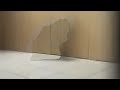
A frame for all these threads is Gabriela Kiczor-Bentkowska’s video How Long This Memory Lasts. The artist works with gradations of low resolution, but does not fetishise them as a relic of older, cruder graphics. She uses them deliberately, as an artistic tool, to pose a personal question about the “resolution” of her own memories and relationships with others. Her figure is absent from the frame and only the background is visible, yet her outline emerges from the pixelated surroundings. Is this absence not also a question about our presence on social media, where we are at once visible and elusive, and about the uncertainty of identity in a world ever more saturated with AI and virtuality?
The virtual presentation extends the exhibition Modal Model, held on 5 November 2026 at the Faculty of Media Arts of the Academy of Fine Arts in Warsaw. The exhibition accompanied The 3rd Conference Ethics and AI: Towards a New Ethos of AI, which took place on 4–6 November 2026 at the Warsaw University of Technology.
Organised by:
3D & Virtual Occurrences Studio I
(Assoc. Prof. Piotr Kopik; assistant Andrzej Szwabe)
3D & Virtual Occurrences Studio II
(Assoc. Prof. Jakub Wróblewski; assistants Andrei Isakov, Sebastian Sebulec)
Media Art Faculty, Academy of Fine Arts in Warsaw
15 Spokojna Street, Warsaw